Love, Control, and Collapse
A clinical examination of how dependency, guilt, validation withdrawal, reality distortion, and future-faking combine into a single, self-reinforcing system of psychological control — one pattern at a time, across 33 chapters.
Digital ebook · ₹129 · Instant access after payment
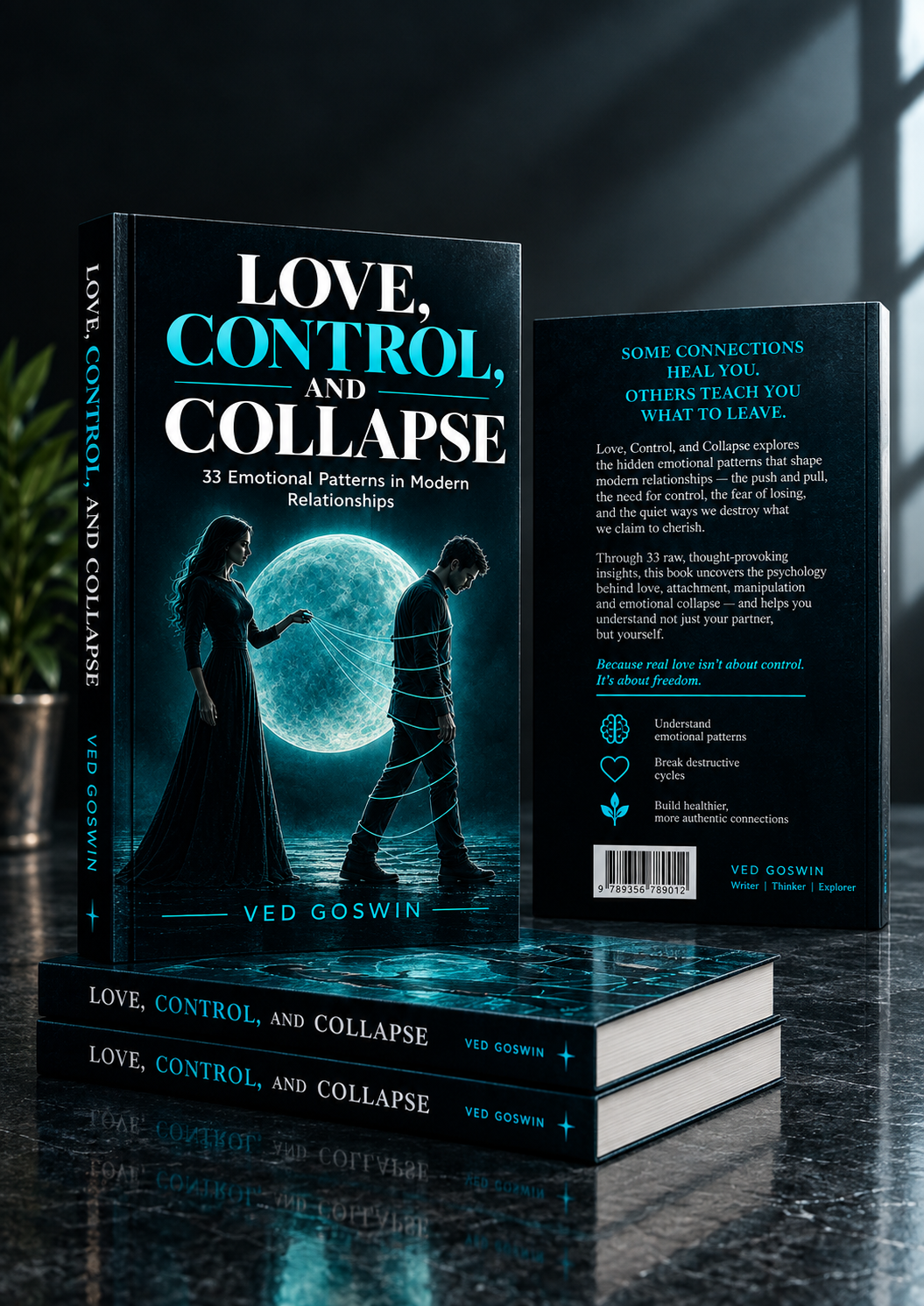
What happens when emotional dependence stops being affection and becomes an arrangement — one person's need quietly reorganizing another person's reality?
This book argues that control rarely arrives as a single dramatic event. It accumulates through repeated emotional patterns — small, individually defensible, easy to rationalize — until a person's internal sense of what is reasonable has been replaced by an external one. No single sentence does this. The accumulation does.
One analytical framework, applied with total consistency
Each of the 33 patterns is examined individually, in depth, and the book also studies how multiple patterns operate together — reinforcing each other in sequence rather than functioning as isolated incidents.
Each examined as its own chapter, in full.
Patterns grouped by the control function they serve.
The same structural lens applied to every chapter.
The categories of control examined
Each part groups the psychological tools used to establish and maintain a particular kind of leverage.
Dependency Construction
Establishes the target as the sole source of connection, converting his ordinary availability into an unspoken debt.
Surveillance and Possession
Narrows his autonomy and social world, framing restriction in the vocabulary of closeness and destiny.
Victimhood and Guilt Induction
Reverses accountability so his ordinary conduct is read as the cause of her distress.
Ultimatums and Artificial Urgency
Removes his time to deliberate, replacing it with decisions made under manufactured pressure.
Reality Distortion
Destabilizes his perception until his own account of events is no longer one he trusts.
Conditional Love
Turns affection into something owed, demonstrated, and continually re-assessed.
Withdrawal and Punishment
Trains avoidance through the calculated removal of attention and warmth.
Sacrifice Narrative
Constructs an unpayable debt out of claims of total devotion and effort.
Catastrophic Consequences
Attaches a permanent, unbearable cost to the idea of leaving.
Future-Faking
Keeps him invested in a horizon of commitment that never actually arrives.
Blame Reversal
Makes him responsible not only for his own actions but for her reactions and her character.
Comparative Guilt and Abandonment Narratives
Draws on social norms and past wounds to close off whatever exit remained.
A selection from the table of contents
The Illusion of Exclusive Dependence
“I only talk to you; if you don't give me time, who should I talk to?”
The Interrogation of Delay
“Why do you reply so late? Who are you talking to?”
The Complaint of Comparative Neglect
“Okay, you talk to everyone else, but you don't get time for me?”
The Threat of Permanent Departure
“Either listen to me, or I'll leave forever.”
The Denial of Observable Behavior
“You overthink too much; I didn't do anything.”
The Test of Devotion
“If you truly love me, then prove it.”
The Announcement of Silence
“Fine then, I won't talk to you anymore.”
The Prediction of Complete Ruin
“If you leave me, I'll be completely ruined.”
The Promise of Permanent Union
“I'll marry you and make you mine — just wait a little.”
24 further patterns are examined in the complete edition, each with its own five-stage analysis.
Every pattern, examined the same way
This is not a collection of loose observations. Each of the 33 chapters follows an identical five-stage structure, so patterns can be compared against each other with precision.
What the pattern claims on its surface, and the structure it quietly installs underneath.
The specific psychological lever — scarcity, guilt, urgency, distortion — that makes the pattern function.
The ordinary, often admirable qualities in the target that the pattern depends on.
How the pattern accumulates in stages, each one small enough to rationalize on its own.
The condition that results once the pattern has become the background fact of the relationship.
An interconnected system, not isolated terms
These mechanisms recur throughout the book. No single one operates in isolation — each prepares the ground for the ones that follow.
Positioning, not a verdict on other books
This isn't a claim that other relationship books fall short — only a clear account of what this one sets out to do differently.
This book may be for you if...
Inside the edition
The Illusion of Exclusive Dependence
“I only talk to you; if you don't give me time, who should I talk to?”When one person is declared the only source of another's connection, availability stops being a choice and becomes an obligation. The chapter traces how a sentence that sounds like trust can quietly install a structure — one in which time given freely is slowly replaced by time that cannot be withheld without cost.
Love, Control, and Collapse
33 Emotional Patterns in Modern Relationships
- Digital ebook / PDF
- 33 chapters, one per pattern
- 12 thematic parts
- A structured, five-stage psychological analysis
- Professional digital edition
Love, Control, and Collapse
33 Emotional Patterns in Modern RelationshipsGET THIS EBOOK · ₹129Digital ebook · Instant access after payment
This book does not tell you what to do. It shows you how the system works — the architecture, not a verdict, and not a plan.LOVE, CONTROL, AND COLLAPSE · CONCLUSION
Common questions
Examine the architecture. Understand the pattern. See the system.
Love, Control, and Collapse
33 Emotional Patterns in Modern Relationships
Get This Ebook · ₹129